You’re Lost in the Forest. Now What? 12 Survival Life Hacks That Could Actually Save Your Life
You’re probably and hopefully not lost in the forest right now — but these survival life hacks might be the most useful life hacks you ever come across, and that’s not an exaggeration.
Here’s the thing about survival techniques: you never know when something you casually read is going to be the exact information that saves your life.
Like, there’s this story that keeps showing up on my feed about a little girl who learned somewhere (school, TV? I don’t remember) that if an alligator has you in its jaws, you jam your fingers into its nostrils and it will release you. Then one day, in what had to be the most unlucky day of her life, an alligator actually grabbed her. She did exactly that. It worked.
So if you’re someone who loves hiking, nature, or just the wilderness in general, read these survival hacks now, before you need them. Then try to memorize at least a couple, and save them.
If You Can’t Find Water, Suck on a Stone
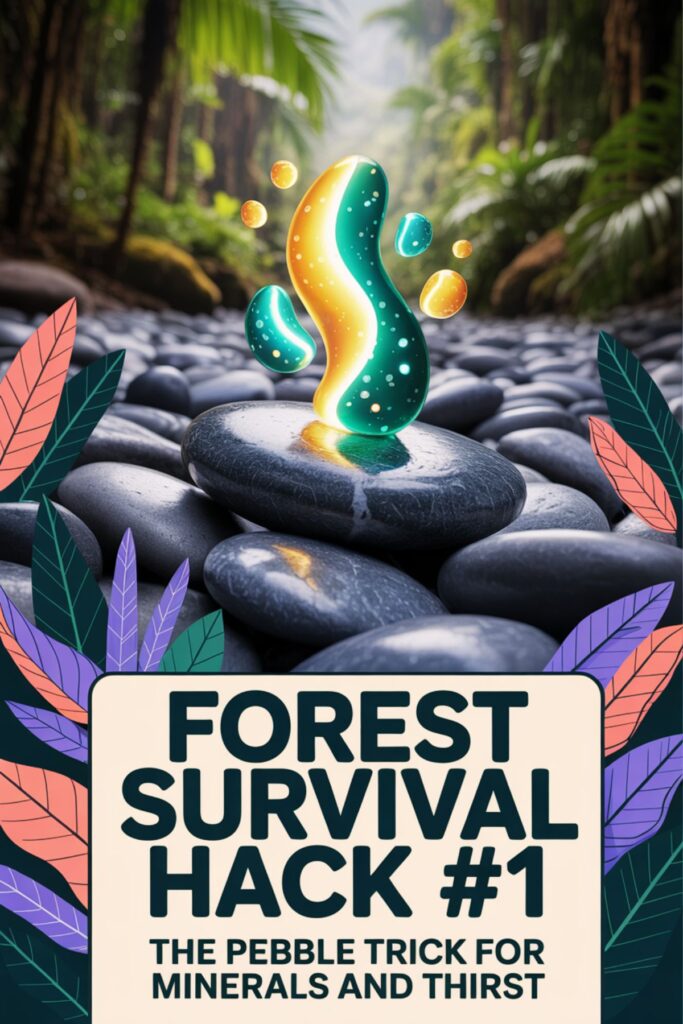
A guide told me this one during a hike through the Amazon in Peru. He’d learned it in the Peruvian army as a survival technique: when water is scarce, keep a small, smooth, clean pebble under your tongue for long stretches at a time. The reason is the minerals.
Out in the jungle, you’re sweating out electrolytes constantly, and a mineral-rich stone held under the tongue can slowly release trace minerals your body is desperately missing.
It also keeps the thirst sensation from completely taking over your brain.
Find Water by Following Animals, Not Maps
Water flows downhill, always, so start moving slowly and carefully downhill. But here’s the survival hack that most survival tips completely skip: follow animal tracks. Animals are not stupid. They have mental maps to the nearest water source, and fresh tracks in soft mud mean water is close.
Birds congregate near water at sunrise and sunset like clockwork too. If you hear a lot of bird activity in one direction at dusk, walk toward it.
Never Drink Straight From a Stream — But Here’s Your Workaround

You know you shouldn’t drink untreated water. You’re thirsty anyway. Here’s what you can actually do:
Boil it. You need a container and fire. A metal water bottle, a tin can, or even thick folded bark held over (not in) a flame can work. Boil for at least 1 full minute, 3 minutes at higher altitude. That kills everything dangerous.
SODIS method. If you have a clear plastic bottle and sunlight, fill it with water and leave it in direct sun for 6 hours. UV rays kill most bacteria and parasites. Slow, but genuinely effective.
The plastic bag filter. Before boiling, pour water through a plastic bag (a clean sock also works) or layered fabric to remove sediment and larger particles. Check out this post with 15 survival hacks using a plastic bag for other amazing tricks.
Stop Walking. Seriously, Stop.
The worst thing you can do when you realize you’re lost is keep moving in a panic. Every step you take away from your last known location makes you harder to find, and it makes you more exhausted and disoriented in the process.
The moment you realize something is off: stop, sit down, and breathe for 60 seconds. Rescuers always search from the last known point. If you’ve been spiraling through the trees for two hours, you’ve made everyone’s job so much harder, including your own.
The survival technique is called STOP: Stop, Think, Observe, Plan. Burn it into your brain right now.
Your Phone Has Exactly One Job Left
Don’t call anyone yet. A voice call will drain your last bit of battery in minutes and might not even connect.
- Switch to airplane mode immediately to conserve power
- Use your compass app — it works with zero signal
- If you have any signal at all, send a text with your GPS coordinates; texts go through on weak signals when calls won’t
- Before your next hike, download Maps.me — it’s free and works completely offline
One coordinate text beats a 3-minute panicked phone call every single time.
Build a Fire Without a Lighter (The Method That Actually Works)
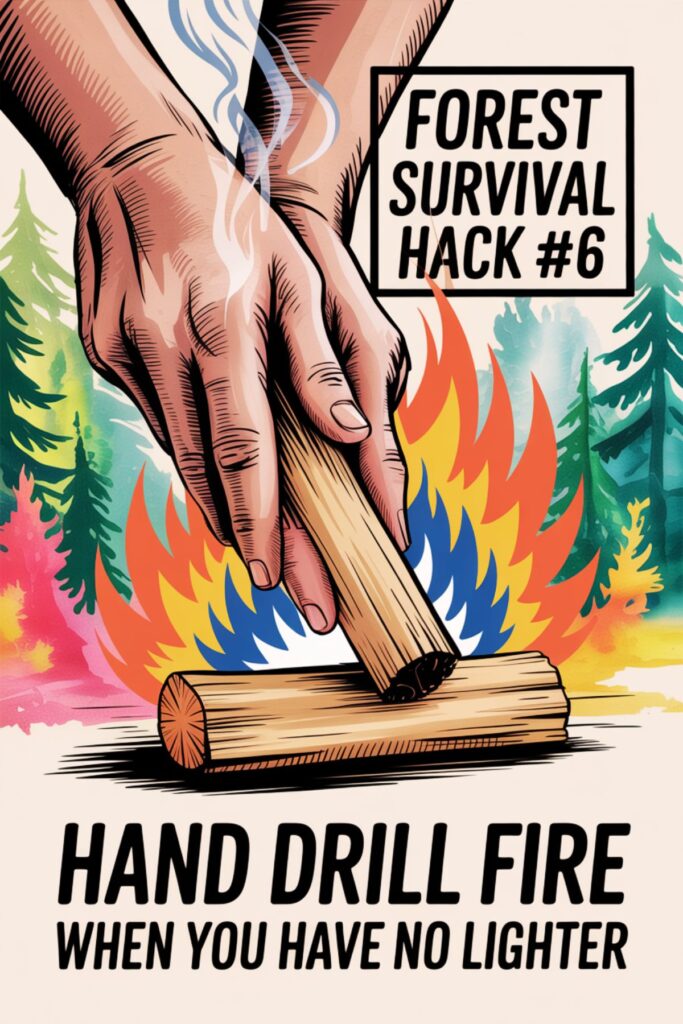

Forget the fantasy of randomly rubbing two sticks together. Here’s the real sequence:
The Hand Drill Method:
- Find a dry, flat piece of softwood (cedar, willow, or cottonwood) for your fireboard
- Carve a small depression and a notch cut into the side of it
- Place a dry leaf under the notch to catch the ember
- Take a dry, straight hardwood stick as your spindle and spin it fast between your palms while pressing down hard
- Keep going for 30 to 60 seconds until you see smoke and a glowing ember drops onto the leaf
- Fold the leaf gently around the ember, blow softly, and transfer to your tinder bundle
➡️If you happen to have lip balm with you, throw it in, because it’s flammable and will burn longer than bare tinder (you can also check out this post on how many everyday items women carry in their bags can double as survival tools).
Bonus cheat: a gum wrapper folded into a narrow hourglass shape, with both ends touching the terminals of a AA battery, will ignite in seconds. Yes, the battery from your headlamp counts.
Walk With a Stick Through Dense Foliage
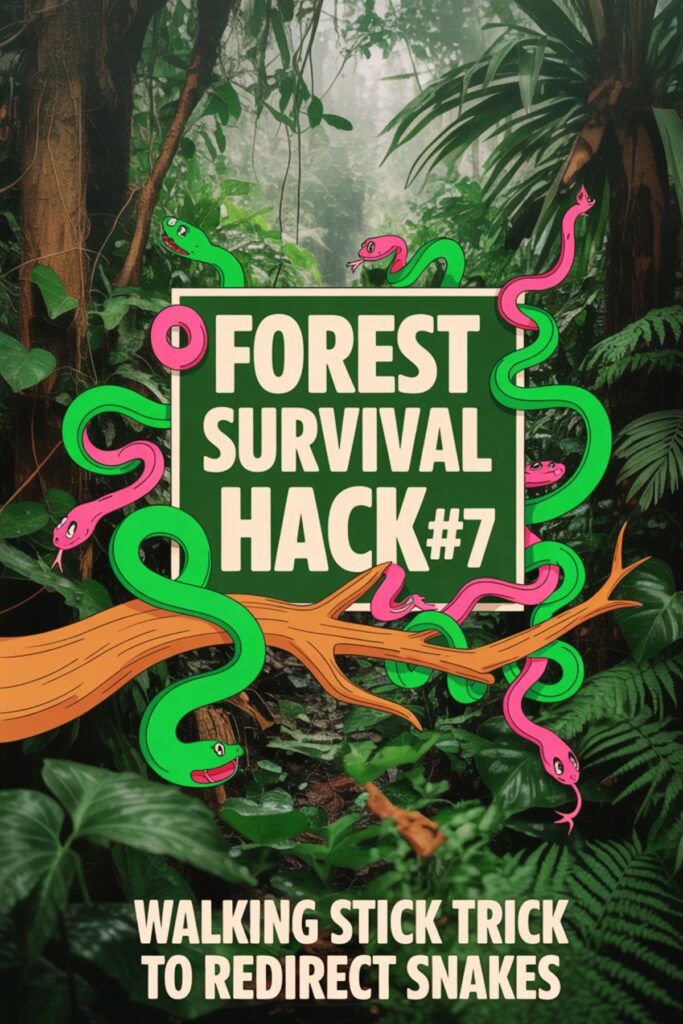
I read a book as a kid about Juliane Koepcke, a teenage girl who survived a plane crash in the Amazon and walked through the jungle alone for 11 days until she found people.
One thing she did, something her parents who were biologists and knew the terrain had taught her, was to walk with a long branch held low in front of her through thick undergrowth.
The idea is that if you accidentally step near a snake, it’s far more likely to strike the stick than your leg. Snakes react to what’s closest and most threatening, and a branch prodding through the leaves ahead of you redirects that instinct away from your body.
Are there snakes in forests? Absolutely, yes, depending on where you are in the world. So this isn’t just a jungle hack. Anywhere the ground cover is dense and you can’t clearly see your feet, a walking stick is one of the easiest and most underrated survival tools you have.
Build a Survival Shelter Before You Think You Need One

If you’re not found within 2 hours of sunset, build shelter. Don’t wait until you’re already shivering. Hypothermia can set in at temperatures as mild as 50°F (10°C) when you’re wet and exhausted, which makes this one of the most critical survival techniques to understand before you need it.
The Debris Hut:
- Find a long, sturdy branch and prop one end in a tree fork at waist height, the other on the ground
- Lean smaller sticks along both sides like ribs
- Pile leaves, bark, and branches over the frame until the walls are at least 2 feet thick
- Stuff the inside with dry leaves for bedding
- Crawl in feet-first; your body heat warms the small space surprisingly fast
The most common mistake: not piling nearly enough debris. Thin walls give you zero insulation. More is always more here. This is one of those survival shelter ideas that looks simple but works incredibly well when done right.
DIY Compass Tricks That Actually Work
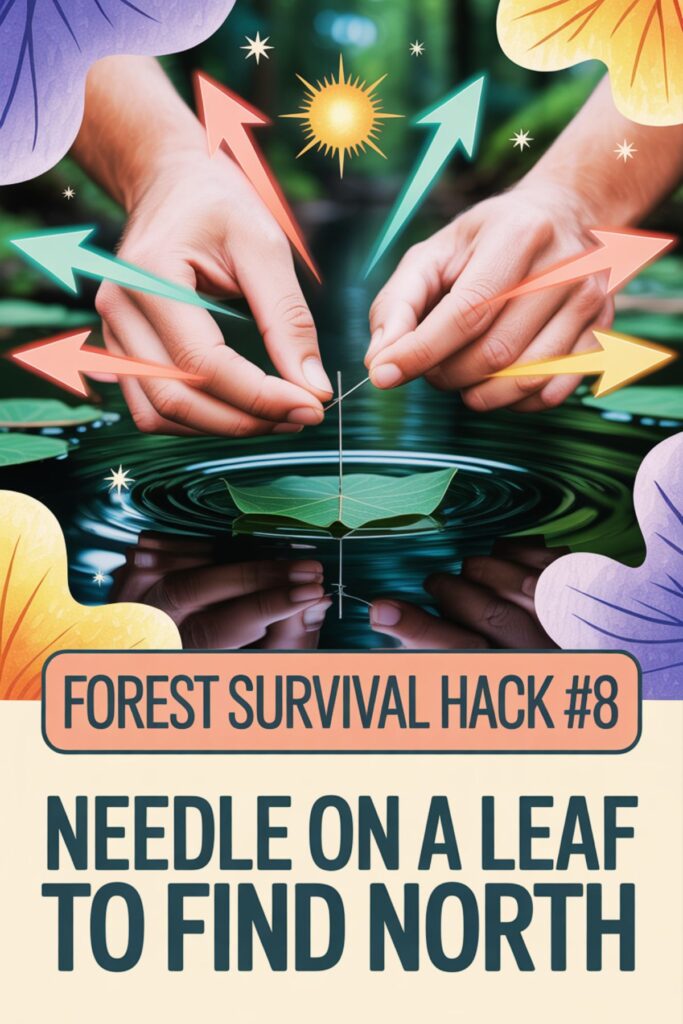

No compass in your survival bag? Three options:
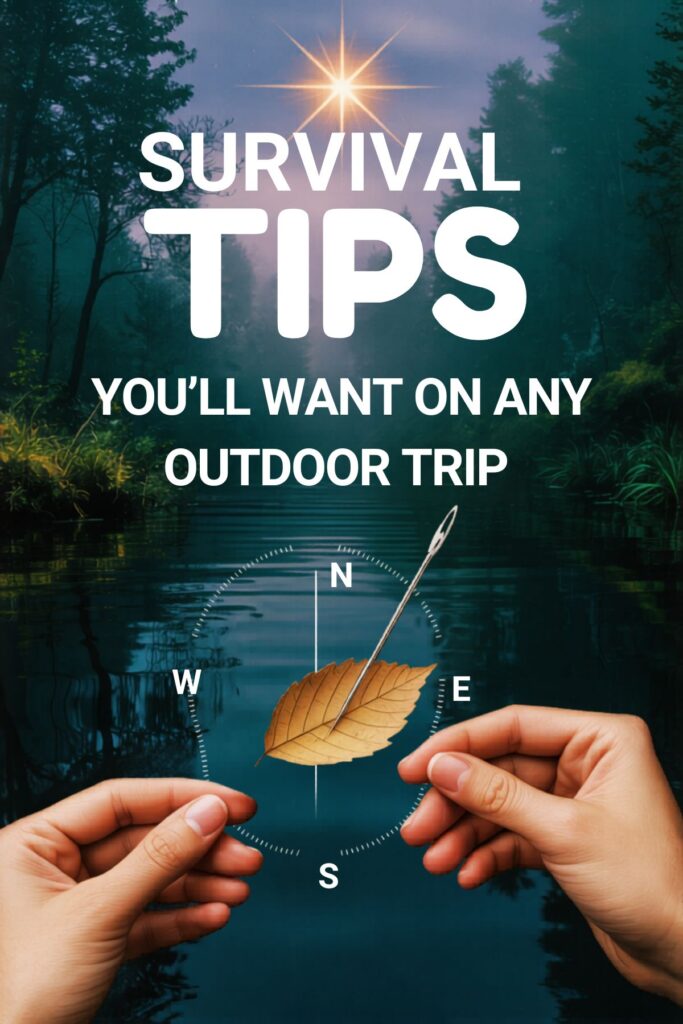
The needle trick: Rub a needle, pin, or metal zipper pull against your hair or wool in one direction for 30 to 40 seconds. Float it on a leaf in still water. It will rotate to point north/south.
The shadow trick (daytime): Push a stick into the ground. Mark the tip of its shadow with a stone. Wait 15 minutes, mark the new shadow tip. The line between the two rocks runs east to west. First mark is west, second is east.
The North Star (night): Find the Big Dipper. Draw an imaginary line through the two outer stars of the cup. That line points directly to Polaris. Polaris equals north. Full stop.
Signal for Rescue Like You Mean It
Three is the universal distress signal. Three of anything.
- Three whistle blasts, pause, repeat (a whistle carries 3x farther than screaming and uses a fraction of the energy — honestly one of the most essential survival items you can carry and one of the most overlooked)
- Three fires in a triangle formation if you can manage it
- Three rocks stacked on top of each other at intervals as you move
If you have a phone screen, compact mirror, or even the shiny inside of a chip bag: flash it toward the sun. A reflected signal is visible up to 10 miles away on a clear day. Your voice carries maybe a quarter mile.
For air rescue, use rocks, logs, or sticks to spell out a giant SOS or X in an open clearing. Make it at least 10 feet wide. Rescuers in helicopters look down, not sideways.
What You Can Actually Eat (And What to Leave Alone)
Foraging in a panic is how people get poisoned. Keep it simple and stick to what you actually recognize:
- Pine needles: Chew young, bright-green tips for Vitamin C; spit, don’t swallow
- Cattails: Found near water; the starchy root can be boiled like a potato, the green seed head is edible raw
- Dandelions: Entirely edible, every part. If you recognize it with certainty, eat it.
- Blue and black wild berries: Generally safer than red or white, but only if you are completely certain. When in doubt, leave it.
The universal edibility test for true emergencies when you have no idea what something is: Touch it, smell it, do a tiny skin test, wait 8 hours, take a tiny taste, wait 8 more hours. If nothing happens, eat more. It takes time you might not want to spend, but it works.
Stay Warm With Basically Nothing
Hypothermia is the quiet killer in survival situations; it’s not just cold temperatures, it’s wet plus wind plus exhaustion combining.
- Stuff your jacket and pants with dry leaves or dry grass. Sounds ridiculous, works brilliantly. Trapped air equals insulation equals warmth — exactly the same principle as a down coat.
- Never sleep directly on the ground. The ground pulls heat from your body far faster than cold air does. Pile bark and leaves underneath you before you lie down.
- Cover your head. You lose up to 40% of body heat through your head. Use your jacket, your bag, anything available.
- Curl into a fetal position to minimize the surface area exposed to cold air.
The Survival Hack Nobody Talks About: Your Brain
Here’s the truth that survival experts know: most people who die in wilderness emergencies were physically capable of surviving. The brain decides to give up before the body does, and that’s the real danger.
Give yourself a micro-task every 20 minutes. “I just need to find water.” Then: “I just need to start this fire.” Each small completed task releases dopamine and keeps you from spiraling into helplessness. Talk out loud to yourself too — it sounds odd but it keeps your thoughts organized and prevents the kind of mental fog that gets people killed. And remind yourself: people have survived 10 or more days with nothing. You are not as fragile as you feel right now.
This is honestly one of those everyday hacks from the survival world that applies everywhere. Break the overwhelming thing into the smallest possible next step. Works in the forest, works in life.
Build Your Survival Kit
You don’t need a massive or expensive setup. You need five things clipped to your pack or tossed in your survival bag before every single hike. Total cost: under $25. What it buys you: the ability to signal, stay warm, make fire, and navigate — that’s the whole game.
- A survival whistle — light, loud, and completely non-negotiable: shop whistles
- A ferro rod fire starter — works when wet, lasts for years: shop ferro rods
- Water purification tablets — weigh nothing, save everything: shop purification tablets
- A mylar emergency blanket — folds to wallet size, reflects 90% of body heat: shop emergency blankets
- A mini compass — because your phone will die: shop mini compasses
If you want everything in one go, a solid survival kit or survival pack covers most of these bases. Also worth keeping at home or in your car: an urban survival kit for emergencies that don’t happen in the woods.
More Survival Life Hacks
If this post sent you down a rabbit hole (welcome, it’s a good rabbit hole), here are more survival skills life hacks worth bookmarking:
- You probably already have survival tools in your everyday bag without knowing it — here are 15 items that could save your life
- One single plastic bag has more survival uses than most people’s entire survival pack — read the full breakdown
- Cold weather completely changes the survival equation — these winter life hacks could literally save your life
Sae this pin!